You're at the lake. You're down the river. You can see cormorants on the water. You've seen them before — dozens of times. And every time, you think someone should be doing something about it. But that observation disappears the moment you pack up and drive home. Multiply that by a thousand anglers across the UK and you have the single biggest failure in cormorant management: the data exists, but nobody collects it.
Despite decades of concern and millions spent, the UK still produces only 32 new A06 licence applications per year. The wintering cormorant population stands at over 65,000 birds. The successful infrastructure to turn observation into evidence — and evidence into action — simply hasn't existed. Until now.
The problem was never that people didn't care. The problem was that nobody built a way for you to do something about it in the 30 seconds between spotting cormorants and recasting. Hydroscape is that way — a simple funnel that takes a quick report from your phone and carries it, stage by stage, all the way to the data that could reshape how cormorants are managed across Europe.
Seven stages. Seconds of your time. Continental-scale change.
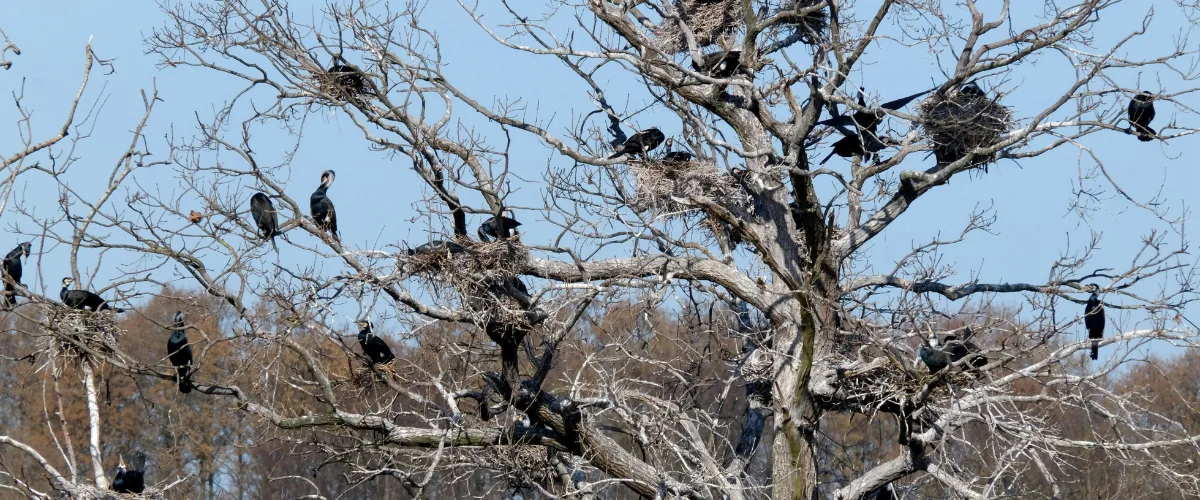
The Report Individual
You're on the bank and there are cormorants on the water. You pull out your phone, open the Hydroscape reporting form — no app download, no login, no account — and in 30 seconds you've submitted a GPS-tagged, timestamped, photographed record of exactly what you're looking at. Then you go back to fishing.
That's it. That's your part. Tomorrow you might do it again — it takes less time than tying a rig. So might the angler at the next lake, and the one after that. Every one of those reports enters the same database, the same pipeline, the same funnel. We'll handle everything else.
Report a Cormorant Sighting FreeAI Verification Individual
The moment your report lands, the system takes over. Your location is pinpointed on a map, your photograph is stored securely, and the record is queued for AI analysis. Within hours, a four-step verification process examines your photo: Is it clear enough? Is it definitely a cormorant? How many birds are in the shot? How confident is the identification?
If the photo is blurry or the ID is uncertain, the record is rejected automatically. No bad data gets through. What comes out the other end is a verified record that can stand up to scrutiny — because if your club ever applies for a licence, a regulator will scrutinise it.
The Pattern Emerges Site Level
One sighting is an observation. A hundred sightings from the same water over six months is a pattern. The platform pulls individual reports together into roost maps, seasonal trends, and distribution analysis. What was invisible — the rhythm of predation at your water — becomes visible.
This is the data that separates a successful A06 application from a rejected one. Natural England doesn't want to know that you saw cormorants once. They want to know how many, how often, at what times of year, and from which roost sites. That's exactly what the pattern reveals.
The Licence Application Site Level
The A06 Master Builder takes all of that pattern data — the verified sighting history, the roost locations, the seasonal distribution, the photographic evidence — and structures it into exactly the format Natural England requires. Their form, their fields, their evidence categories.
Most A06 applications fail because the evidence is incomplete, unstructured, or anecdotal. A paper logbook and three photographs taken on the same afternoon is not a compelling case. Six months of continuous, AI-verified, georeferenced, timestamped data is.
Read the A06 Guide FreeSite Protection Site Level
A granted A06 licence authorises a combination of non-lethal deterrents and, where justified, lethal control. But the licence isn't the end of the funnel — it's the point where evidence-gathering becomes evidence-of-action. Every deterrent activation, every outcome, every follow-up count is logged and feeds back into the system.
Your fishery is now protected by a licence built on data that can be renewed, extended, and defended. Those 30 seconds you spent on your phone between casts gave your club something no amount of committee meetings could produce: a defensible, evidence-based management position.
The National Dataset National
Now multiply your water by hundreds. Every club that reports, every member who submits, every angler who logs what they see — all of it flows into the same national database. For the first time, the UK has a real-time, continuously-updated, AI-verified cormorant population dataset that isn't dependent on a single annual count conducted over one weekend in January.
This is what's been missing. The government's own licensing decisions are based on population estimates — but nobody is systematically counting the birds. The annual winter survey provides a snapshot. Hydroscape provides the film.
Pan-European Action Continental
The Great Cormorant is not a British problem. It's a European flyway species. The inland subspecies that dominates UK waters breeds across the continent from Denmark to the Black Sea. Any serious management strategy requires coordination across flyway nations — and coordination requires data.
Denmark has already demonstrated what's possible: PIT-tagging studies on natural rivers showed 30% of wild trout consumption attributable to cormorants. The Netherlands manages its population through active nest control. France permits regulated shooting. The UK, by contrast, has spent decades arguing about whether the problem even exists — while the wintering population has grown from 2,000 birds in the 1980s to over 65,000 today.
What none of these countries have is a shared reporting infrastructure. Every nation collects its own data, in its own format, through its own systems. There is no pan-European dataset of cormorant distribution, abundance, and seasonal movement — and without one, flyway-level management remains a conversation without evidence.
Hydroscape is already built for this. The reporting forms support 22 European languages. The platform is species-agnostic by design. The AI verification pipeline doesn't care whether the submission comes from a lake in Lincolnshire or a river in Lithuania. The same 30-second report, the same verification, the same national map — scaled across borders. There is no reason this can't become the standard that every flyway nation uses to contribute to a single, unified, continental picture of cormorant populations.
When that conversation happens — and it will — the platform with the data, the infrastructure, and the track record will lead it.

We Bring the Technology. You Just Bring Your Eyes.
You don't need to understand AI verification, database architecture, or diversity indices. You don't need to know what a Cloud Function is or how geocoding works. All of that is our job. Your job is the one thing no technology can replace — being at the water, seeing what's there, and taking 30 seconds to record it.
Hydroscape takes your simple observation and does everything else: verifies it, maps it, analyses it, aggregates it, secures it, and makes it available to the people who can act on it. We've built the most advanced ecological data pipeline in UK citizen science so that your contribution can be as easy as pointing your phone and tapping submit.
And we're not going anywhere. This isn't a project with a funding cycle or a government contract that expires. We have a dedication to this cause and a conviction that the evidence will speak for itself. We will take every report you submit, combine it with the best technology available, and keep pushing — methodically, relentlessly, and with absolute confidence that we are on the right side of this argument — until the regulatory landscape changes. There is no timeline on which we give up and no amount of institutional inertia that will deter us.
This funnel exists because the alternative — the status quo — has failed. The numbers speak for themselves.
That last number deserves a pause. At accepted consumption rates of 400–600g per bird per day across a 65,000-bird wintering population, cormorants in the UK are eating between 4,700 and 7,000 tonnes of fish every winter season. That figure grows with the population — and the population has grown from 2,000 birds in the 1980s to over 65,000 today. This is not a static problem. It is compounding, year on year, and it is doing so largely unmeasured because the reporting infrastructure hasn't existed.
Thirty-two licence applications per year from an industry that manages tens of thousands of fisheries. A wintering population consuming more fish annually than the entire UK coarse fish stocking output. These are not the numbers of a system that's working.
Hydroscape replaces memory with a database, anecdote with evidence, and frustration with a clear path from observation to outcome. Every stage is designed to make the next stage possible. You can't build a licence application without a pattern. You can't see a pattern without consistent reporting. You can't get consistent reporting without a tool that takes 30 seconds and requires no training.
Why Your Single Report Matters
It's easy to think that your one sighting from one lake on one Tuesday afternoon doesn't matter. But the entire system is built from individual reports — from people like you, doing nothing more than spending 30 seconds on their phone when they see something worth recording.
The difference between a fishery that gets a licence and one that doesn't comes down to evidence. And evidence starts with your next report.
If this data is going to change anything, it has to be bulletproof. Not just convincing — auditable. That's a standard we take seriously.
AI Verification on Every Record
Every photo you submit is analysed by AI before it enters the verified dataset. No other UK wildlife platform does this. If the identification is uncertain, the record is rejected automatically. The data that gets through is data you can put in front of a regulator with confidence.
Secured to Bank-Level Standards
The platform is tested against the same security framework that banks are audited against — and scores 9.9 out of 10. All data is stored in the UK. Your personal information is protected. Four independent security scans, all top grade. When someone asks "is this data secure?" the answer ends the conversation.
Tamper-Proof Records
Every record on the platform is logged in an audit trail that cannot be edited or deleted — not even by us. The chain from your original submission to the final analysis is intact and verifiable. If it ever needs to stand up in a licensing review, it will.
Works Without Signal
Your water doesn't have WiFi. We know. Every reporting form works offline — your submission saves on your phone and syncs automatically when you're back in range. You'll never lose a report because you were out of signal.
Start Reporting. Start the Change.
30 seconds between casts. No app. No login. No training. Just you, your phone, and the cormorants you can already see. That's all it takes to contribute to the biggest shift in UK cormorant management in a generation.
From Predation to Protection — Your A06 Licence Guide
A free 10-step walkthrough of the entire A06 licence application process. From first sighting to Natural England approval — every requirement explained, with free tools at every stage.
Read the GuideDon't Invest in Feelings — The Cormorant Debate
A detailed, evidence-based analysis of the UK cormorant management debate. Peer-reviewed research, FOI licensing data, and the science that both sides need to confront.
Read the ArticleCormorant Subspecies Identification Guide
Sinensis or carbo? The subspecies you're reporting matters for your licence application. A visual guide to telling them apart in the field.
View the GuideHydroLibrary — 497 UK Species
A searchable database of every species you're likely to encounter on UK freshwater. Conservation status, identification features, and ecological context for each entry.
Explore the Library